Color stability
What the QUV testing shows
In accelerated weathering QUV testing (ASTM D4587, 500 h, gray test panels), a published comparative study recorded ΔE of 8.83 for epoxy and 4.83 for polyurea. Another independent source reports ΔE of 10 for epoxy with no protective topcoat, and ΔE of 2 only for formulations developed specifically as low-yellowing.
The reference standard criterion is that of SSPC-Paint 36, which considers a color change perceptible from ΔE* 2.0 (calculated per ASTM D2244), associated with gloss loss of up to 25%. The standard grades performance by the time taken to reach that threshold: Level 1 from 500 to 999 h, Level 2 from 1,000 to 1,999 h and Level 3 from 2,000 h on.
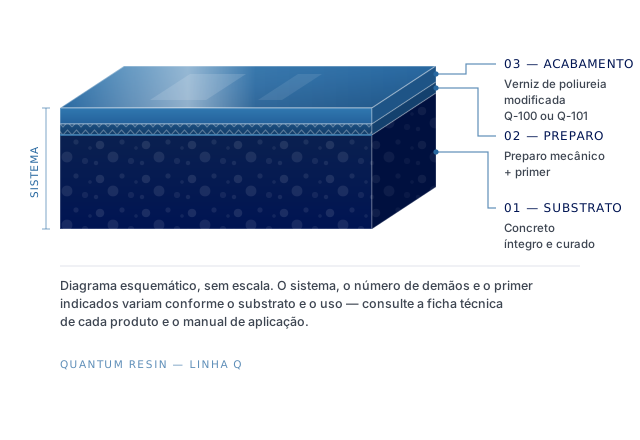
On that scale, Q-100, with ΔE < 2.0 after 2,000 h of QUV, falls in the Level 3 band, and Q-101, with ΔE < 1.5 after 1,000 h, in the Level 2 band.
* Comparison against generic product classes, at typical formulation values; it is not a specification. The ΔE figures for other resin classes are data published by third parties, obtained on specific test panels, formulations and test cycles, and serve only as an order-of-magnitude reference. They are not Quantum Resin measurements and do not characterize any competing product. Accelerated weathering tests define exposure conditions, not acceptance criteria, and have no fixed correlation with natural exposure; they should be read as a relative comparison between systems tested under the same conditions. ASTM D2244 is a practice for calculating color difference and does not set an acceptance limit. Consult each product's technical data sheet and our team for project-specific conditions.